

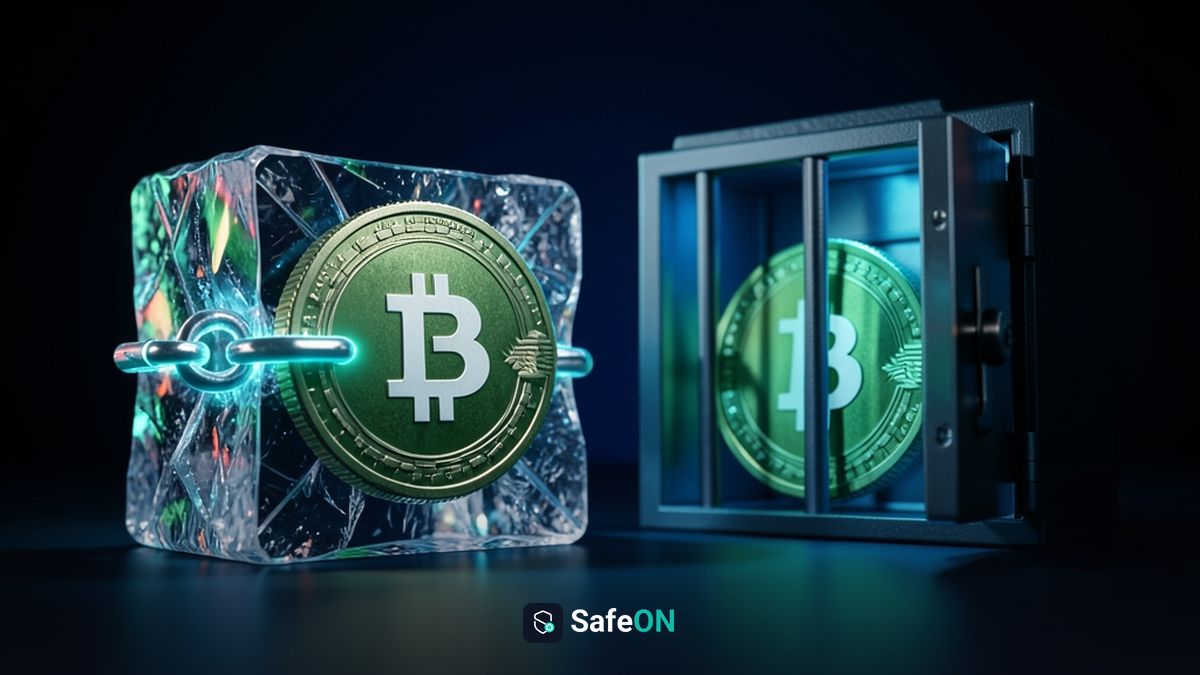
You receive 20,000 USDT for a trade, the transaction confirms, and a week later you try to move it and nothing happens. So can USDT be frozen? Yes, and in two different ways. Tether can blacklist an address at the token-contract level, which locks the USDT in that address no matter what wallet holds the keys. Separately, an exchange can put a hold on your account or a deposit while it reviews it. The first is an on-chain freeze. The second is a platform decision. They have different causes, different signs and different next steps, so the first job is working out which one you are facing.
Can USDT be frozen? The short answer
USDT is not a native coin like TRX or ETH. It is a token issued by Tether, and its balances live inside a smart contract on each network (TRON, Ethereum and others). That contract lets the issuer blacklist an address. Once an address is blacklisted, the USDT in it cannot be sent, whether the wallet is on an exchange, in a mobile app or on a hardware device. Holding your own keys does not protect a USDT balance from a contract-level freeze.
This guide keeps the contract mechanics short. For how the blacklist works in detail, see our explainer on what a USDT freeze is and how Tether applies it.
Tether blacklist vs. exchange hold: two different freezes
Use these signs to tell them apart before you contact anyone.
| Sign | Tether blacklist (on-chain) | Exchange hold (platform) |
|---|---|---|
| Where it applies | The address itself, in any wallet | Your account or a specific deposit on one platform |
| What you see | Outgoing USDT transfers fail; the address shows as blacklisted on a freeze checker | Withdrawals disabled, deposit “under review”, or a request for documents |
| Who decides | Tether, the token issuer | The exchange’s compliance or risk team |
| Other assets | TRX or other tokens in the same address can still move | Often the whole account is restricted |
| Typical next step | Only the issuer can lift it | Answer the exchange’s review through its official support channel |
If you are searching “why is my USDT frozen on Bitget”, on MEXC or on BingX, the funds are almost always in the exchange’s custody, so the first thing to rule out is an account-level review rather than a Tether blacklist.
Why addresses get frozen: what the radar data shows
Contract-level freezes are not rare edge cases. According to the SafeON freeze radar, 492 addresses were frozen in the last 30 days, and the frozen TRON addresses held about 151.4 million USDT at the radar’s latest measurement. That amount is indicative only: it counts TRON balances alone (Ethereum is not in the totals), and a frozen address’s balance can later drop if Tether burns the funds, while the address counts are exact.
Over a longer window, the radar has recorded 12,167 frozen addresses since 2017. Of those, 1,333 were later released. Release happens, but it is the exception, and it is entirely the issuer’s decision.
The radar records that an address was frozen, not why. Freezes are generally associated with funds linked to hacks, scams, sanctioned parties or law-enforcement requests. The pattern that catches ordinary users is indirect: you are paid from an address that is frozen later, or you receive USDT that passed through such an address a few hops earlier. The first can leave your counterparty unable to complete the trade; the second can make your own address look risky to exchanges.
Radar figures describe the market as a whole. They say nothing about any specific person, and a frozen address is not proof that its current holder did anything wrong.
Why is my USDT frozen on an exchange? Common review triggers
Exchanges screen deposits and accounts in their own way, but the triggers fall into a few recurring groups:
- Risky deposit source. Many exchanges check where an incoming deposit came from before crediting it. Funds traced to mixers, scams, stolen-fund clusters or sanctioned addresses can be held for review, and the account can be restricted if the risk is high.
- Exposure to frozen addresses. USDT that recently passed through an address Tether later froze can raise the risk score of your deposit, even if your own address is clean on-chain.
- Verification gaps. Incomplete identity checks, a mismatch between account details and activity, or a change in the account’s location often pause withdrawals until documents are provided.
- Unusual activity. Sudden large deposits followed by immediate withdrawals, or many small transfers from unrelated addresses, are classic review triggers.
The practical point: an exchange hold is often about the history of the funds, not your intent. That is why checking your own wallet before you deposit matters. Our guide to checking a wallet before an exchange deposit walks through it.
How to check whether an address is frozen before you receive USDT
The cheapest moment to avoid a frozen-USDT problem is before the transfer, not after it. Run this checklist on any counterparty address, especially in over-the-counter or peer-to-peer trades:
| Step | What to check | Why it matters |
|---|---|---|
| 1 | Freeze status of the sender’s address | A blacklisted address cannot send USDT, so the trade cannot settle from it |
| 2 | Exposure to OFAC-sanctioned addresses | Sanctions exposure is one of the strongest exchange review triggers |
| 3 | Where the funds came from, a few hops back | Mixer, scam or stolen-fund sources can taint USDT that looks clean at first glance |
| 4 | Behavioural patterns of the address | Fresh addresses, rapid pass-through flows and fan-in from many sources are common in fraud |
| 5 | Your own receiving address | Your wallet’s history is what the next exchange will see when you deposit |
SafeON screens an address on TRON (TRC20) and BNB Smart Chain and returns a risk score from 0 to 100 with the reasons behind it. The report covers USDT freeze and blacklist status (including Ethereum for freeze status), exposure to OFAC-sanctioned addresses, source-of-funds tracing across several hops, and behavioural risk patterns. You can download the report as a PDF to keep a record of what you checked and when. If you already hold USDT that will not move, the frozen USDT check confirms whether the address is blacklisted.
A clean result reduces risk; it does not guarantee that an address will never be frozen or that an exchange will accept a deposit.
Monitoring your own wallet: watchlist and freeze alerts
An address that is clean today can change tomorrow, both its own status and the status of addresses it has dealt with. You can add your own wallet or repeat counterparties to a SafeON watchlist and get alerts, including on Telegram, when their risk or freeze status changes.
Monitoring does not prevent a freeze and cannot reverse one. What it gives you is time: knowing early that a counterparty’s address became risky or was frozen lets you stop trading with it before more funds pass through.
Check a wallet’s risk on SafeON before your next transfer.
FAQ
Can Tether freeze USDT in any wallet, including a self-custody wallet?
Yes. USDT balances are recorded in the token contract, not in your wallet app, so a contract-level blacklist applies to the address wherever its keys are held. Other assets in the same address, such as TRX, are not affected by a USDT blacklist.
Can frozen USDT be unfrozen?
Only the issuer can lift a contract-level freeze. The SafeON radar has recorded 1,333 releases out of 12,167 frozen addresses since 2017, so release is possible but uncommon. SafeON cannot unfreeze, release or recover funds, and this article is not legal advice.
Why is my USDT frozen on an exchange but not on-chain?
Because the hold is the exchange’s decision, not Tether’s. The platform may be reviewing your deposit source, your verification status or unusual activity. Use the exchange’s official support channel and its published terms to find out what it needs.
How do I check if a USDT address is blacklisted?
Run the address through a freeze checker before you send or receive. SafeON shows the address’s USDT freeze status alongside its sanctions exposure, source of funds and overall risk score, so you can decide whether to go ahead with the transfer.